Archaeologists have discovered a trove of artifacts from a 2,000-year-old sunken city off the coast of Egypt, including artifacts bearing the names of biblical pharaohs.
Underwater excavations at Abu Qir Bay revealed statues, remains of houses, temples, artisan workshops and fish ponds, confirming the site as a once thriving city.
Among the finds is a colossal quartzite sphinx inscribed with the cartouche of Ramses II, identified by some historians as the pharaoh from the biblical exodus story, when Moses led the Israelites out of Egypt.
A granite colossus of an unknown Ptolemaic-era man and a white marble statue of a Roman nobleman, as well as a craftsman’s workshop, a stone cistern and a fish pond, were also uncovered.
Researchers also mapped merchant vessels, clusters of stone anchors, and the bases of harbor cranes, shedding light on the bustling activity that once took place along the Nile’s canopic branches.
Egyptian officials suggest that the site may have been part of the long-lost port of Canopus, a center of trade, religion and luxury during Egypt’s Ptolemaic dynasty and the Roman Empire.
The Ptolemaic era lasted for almost 300 years and was followed by Roman rule, which lasted for about 600 years.
Over time, earthquakes and rising seas gradually swallowed the small city beneath the Mediterranean, leaving its treasures preserved underwater for thousands of years.
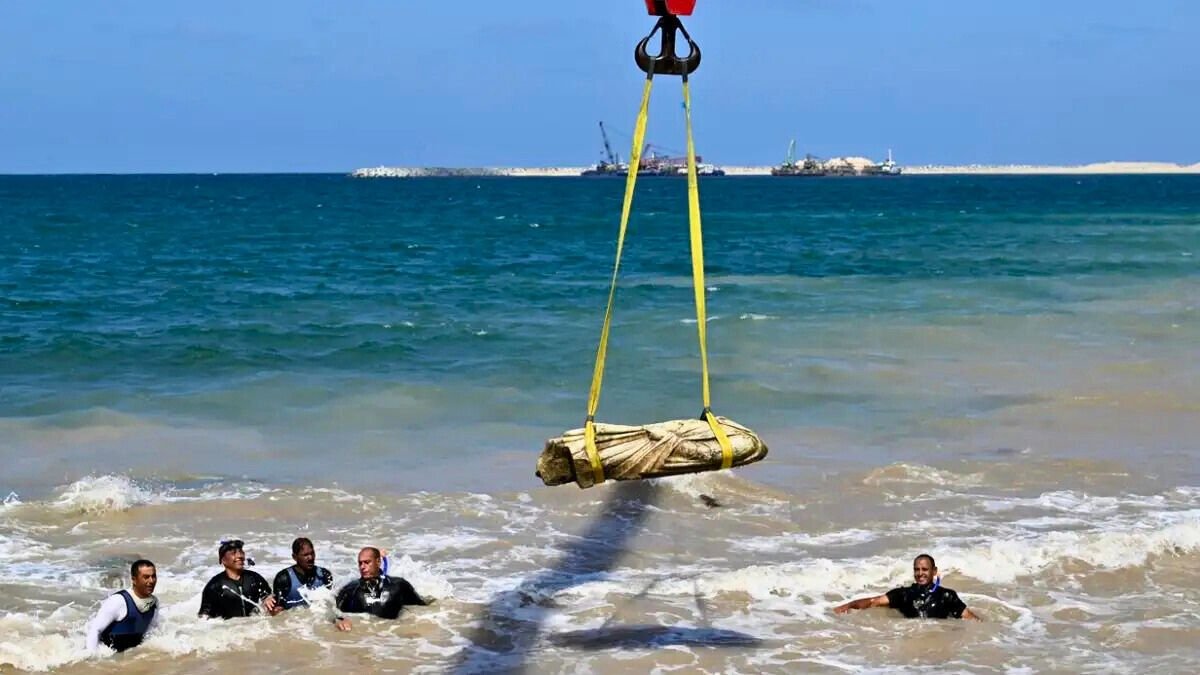
Archaeologists and divers used a crane to pull statues and remains from the waters of Abu Qir Bay in Alexandria.

The artifacts are what remains of the long-lost port of Canopus, a center of trade, religion, and luxury during Egypt’s Ptolemaic dynasty and the Roman Empire.
Egypt’s tourism and antiquities minister Sherif Fath said: ‘There are many things underwater, but what we can bring to light is limited, it is only special material according to strict criteria.
“The rest will remain part of our sunken heritage.”
The colossal Sphinx, with its royal cartouche, not only identifies Ramses II but also provides new insights into the craftsmanship and techniques of royal sculpture during his reign in the 13th century BC.
Ramses II, renowned for his monumental statues and military exploits, is widely believed by historians and popular culture to be the pharaoh who enslaved the Israelites in the biblical exodus story.
According to the Biblical narrative, Moses led the Israelites out of Egypt, parting the Red Sea and guiding them to the promised land.
While the story is steeped in legend, the discovery of a sphinx bearing the name of Ramses II adds a tangible connection to this ancient history.
The Abu Qir excavation, Egypt’s first major underwater operation in 25 years, underscores the country’s ongoing commitment to protecting its unique cultural heritage while providing a rare glimpse into the splendor of its submerged cities.
Fathy hailed the operation as a ‘remarkable milestone’ in Egypt’s efforts to protect its unique cultural heritage.

Ramses II, famous for his colossal statues and military conquests, is widely thought by historians, and in popular culture, to be the pharaoh who enslaved the Israelites in the biblical exodus story.

Excavations at Abu Qir have uncovered the remains of a submerged Roman-era city, complete with temples, cisterns, fish tanks and an ancient jetty, possibly an extension of the famous city of Canopus.
Canopus was an important ancient Egyptian city and port located near the Western Nile Delta, east of modern Alexandria.
Lihat Hasil Lainnya:
The city’s harbor and river channels supported trade with Greece, Rome and the wider Mediterranean, handling goods such as grain, pottery and luxury goods.
Canopus was also famous for its temples, festivals and religious entertainment, and it housed a temple dedicated to the god Osiris.
Osiris is the ancient Egyptian god of the underworld, death, rebirth and agriculture.
Under Roman rule, the city became a retreat for wealthy citizens and rulers, known for its gardens, luxurious villas, and grand architecture.
However, Canopus is gradually declining due to earthquakes, tsunamis and rising sea levels.
At the end of the 2nd century BC, parts of the city were destroyed by liquefaction, and over time, most of it sank beneath the Mediterranean, while other parts were buried under sediments near Abu Qir Bay.